Tag Archives: bible

Torah Law v. Spiritual Fruit? What is relevant in the New Covenant concerning law and obedience?

Torah Law v. Spiritual Fruit? What is relevant in the New Covenant concerning law and obedience?

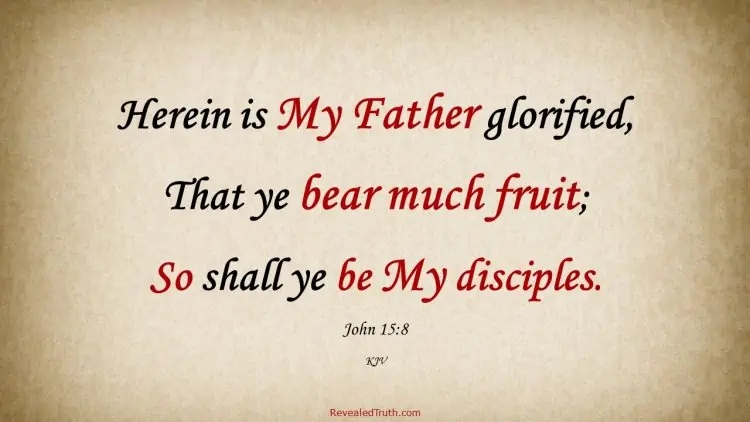
Jesus preached “fruit” (Matthew 7:15-20; John 15) as obedience to His commandments and Jesus told us that the Father is honored by the fruit produced through the Spirit via those who love Him and have trusted in Him for salvation by faith (John 15:8). Jesus said that those who produce much fruit honor the Father and this fruit honors all commandments, both those of His New Covenant Ministry and those etched in stone on Sinai.

________________________________

Jesus said,

8 By this my Father is glorified, that you bear much fruit and so prove to be my disciples. 9 As the Father has loved me, so have I loved you. Abide in my love. 10 If you keep my commandments, you will abide in my love, just as I have kept my Father’s commandments and abide in his love. 11 These things I have spoken to you, that my joy may be in you, and that your joy may be full.

16 You did not choose me, but I chose you and appointed you that you should go and bear fruit and that your fruit should abide, so that whatever you ask the Father in my name, he may give it to you. 17 These things I command you, so that you will love one another. John 15 (ESV)

___________________________________

Concerning Divine Fruit as the fulfillment of “law” in the New Covenant,

When one is born again by faith in Jesus (John 3), they receive the indwelling Holy Spirit via New Covenant promise (Ezekiel 36:27) as the Holy Spirit is the Guarantor and Seal of New Covenant relationship with the Father (Ephesians 1:13-14; 4:30) .

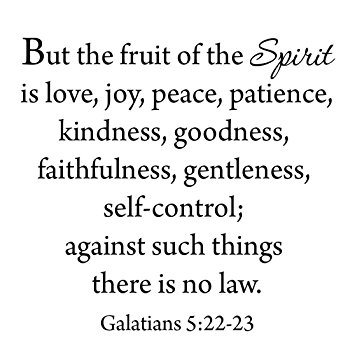
It is the indwelling Holy Spirit, during daily sanctification in the New Covenant (Galatians 5:16), that employs the spiritual law written upon the human heart (Romans 2:14-15; Hebrews 10:16; 2 Corinthians 3:3; Jeremiah 31:33; Ezekiel 11:19) and mates that spiritual law with the redeemed conscience of the “new creation” in Jesus (2 Corinthians 5:17) and the Spirit produces divine fruit through the faithful in Jesus and this fruit fulfills all law, codified/Sinai and Spiritual (Galatians 5:16:23).

This New Covenant promise has NOTHING to do with Torah or Torah Law other than the fulfillment of New Covenant eschatology expressed through the prophets Jeremiah and Ezekiel and the fulfillment of all the Levitical blood sacrifices foreshadowed, but the spiritual law, the new creation (redeemed conscience), the Spirit producing divine fruit through the redeemed, are unique divine elements of the New Covenant and the Gospel of Grace actuated by faith in Jesus as Messiah and the blood He shed as atonement for our sin on Mount Golgotha (Matthew 26:28). The New Covenant’s fruit is NOT a reiteration of the Old Covenant’s Torah (2 Corinthians 3).

Why did Elohim Create the Heavens, the Earth? A brief explanation…

Why did Elohim create the Heavens and the Earth? A brief explanation…

Why did Elohim create the Heavens and the Earth?

When students of Scripture and history reflect upon the wars and death and suffering and calamity that manifests throughout the Torah and subsequently to this very day, they wonder why a loving and compassionate Creator would permit such chaos. What most do NOT understand is the causation and purposes under girding our creation and this temporary Realm of Time constrained by physics.

You and I are in this cosmic vacuum due to an unfathomable war that was initiated in the Kingdom of Elohim before Time was created and all that we perceive with our senses and beyond is the resultant of that war and Elohim’s endeavor to restore order and peace to His Kingdom while simultaneously maintaining volitional love with His angelic creation; an angelic creation that Elohim loves and cherishes beyond human comprehension.

It is critical to understanding causation for the creation narrative that the previous 6000-years of horror are a bulwark against future rebellion in the Kingdom where free will exists by necessity; this, as Elohim is allowing the evil introduced by a rebellious anointed cherub angel to play-out within the constraints of Time and physics for all to see and the conclusion of the matter will be that obedience and loyalty to Elohim and His sovereignty is the only sustainable path to a life (both spiritual and physical) worth living and that rebellion, selfishness, covetousness, self-righteousness, are unsustainable pathways to horror, sorrow, death, nihilism.

All that we confront with our senses in this temporary life within a temporary World and Heaven is an eschatological bulwark against future rebellion in the Kingdom where free will remains extant by necessity concerning intimacy with Elohim. The primary reason Messiah Jesus entered the Realm of Time was to defeat, destroy, the works of that rebellious anointed cherub and the one-third of the angelic creation that followed him in the Great Kingdom War (1 John 3:8b); this, with the precarious strategy of maintaining volitional love with His cherished angelic creation.

_____________________________________

Elohim explains causation, reasoning, for the creation narrative from the Genesis to the Revelation; in fact, we see the introduction of the major players, the war, the battle strategy, introduced within the first-three chapters of the Genesis narrative.

— In Genesis 1:1, “Elohim” introduces Himself via a plural noun with a singular verb.

— In Genesis 1:2, The Holy Spirit introduces Himself as the Logistical Overseer of all things created.

— In Genesis 1:26-28, we see the collaboration of Elohim as “Us” and “Our” – Father-Son-Spirit creating the complex human genome in the spiritual image of Elohim thereby imparting certain divine communicable attributes into the human genome specifically for Elohim’s eschatological purposes going forward.

— In Genesis 3, we’re introduced to the rebellious cherub angel that initiated the Kingdom War and that angel has been extricated from the Kingdom and placed partially within the constraints of Time and physics and allowed access to human kind (Ezekiel 28:11+); this, as Jesus tells us that He watched Satan fall from Heaven like lightening (Luke 10:18).

— In Genesis 3:15, we see the declaration of war between Satan and Jesus (Jesus, born of the virgin seed of the woman to circumvent the Adamic sin-nature) and the prophecy that Messiah would be victorious over Satan as crushing the head of Satan but that Jesus would not be unscathed but receive a “bruised heal”…a death suffered on the Cross.

— In Genesis 3:21, we see the divine battle strategy, the Gospel, that Elohim would employ to defeat the works of the Devil (death-Hell-the grave) through the imputation of righteousness, a gifting of righteousness that Elohim, Himself, would provide via the shedding of innocent blood to clothe sinful humanity in an imputed “robe of righteousness” that mankind could not earn, did not deserve; this, as Elohim rejected the works of mankind to cover his own sin and shame by the works of his hands exemplified by the “fig leaves” Adam used to cover his own shame and nakedness. This is the Gospel of Jesus Christ which was ordained “before Time began” (2 Timothy 1:8-10).

Conclusion,

From the Genesis forward, we see Elohim’s eschatological plan working through and around human kind’s free will choices; this, through the Adamic and Noahic generations, through Noah, Shem, Abraham, Isaac, Jacob, Judah, Messiah…this eschatological plan can be followed through the Scriptures as the Holy Spirit methodically explains the who, what, where, when, why, how, concerning the Realm of Time, our purpose within it, and the closure of Time and physics, the New Heaven and the New Earth, the New Jerusalem. All one must do is possess a heart that is willing to receive and believe and seek and study via our Divine Teacher, the precious indwelling Holy Spirit given to all who “believe” Jesus is Messiah (Ephesians 1:13-14; 1 John 2:27).

“Rich Young Ruler” and Jesus’ Command “Keep the Commandments” – Legalism or Faith? Mt. 19:16-22

Why has the Holy Spirit included Jesus’ discourse with the “rich young ruler” in Matthew 19? What is Jesus teaching?

A theological response to the confusion…

In Matthew 19:17, Jesus is in a theological discourse with a wealthy young man who approached Him asking “What must I ‘do’ to ‘inherit’ eternal life?”

Why do you call me good?

The very first thing Jesus did, out of compassion, was to provide the young man an opportunity to acquire eternal life by “faith” in Jesus as Messiah-Elohim; that is, Jesus asked, “Why do you call me ‘good’ seeing that no one is good but Elohim?” Had the young man possessed the faith, spiritual insight, to acknowledge Jesus as Elohim the Messiah, eternal life would have been granted immediately (Romans 10:13). Unfortunately, the young man did not recognize or acknowledge Jesus as Messiah; therefore, Jesus, knowing the young man’s thoughts, provided the only other alternative to eternal life, Jesus commanded, “Keep the Commandments.” The young man then assumed himself on fertile ground as he felt himself to be righteous due all of his efforts to keep the Commandment; therefore, he asked Jesus, “Which ones?” Jesus recited a number of moral commands to which the young man boldly and proudly stated that he had kept them; then, Jesus proceeded to demonstrate to the young man that he had NOT kept the Commandments but had failed to keep the Greatest of Commandments; Jesus, once again, provided the young man a second opportunity to find eternal life by faith and commanded the young man to “follow me.” Jesus told the young man to sell all of his wealth, distribute it to the poor and “follow me!” Had the young man complied by faith, eternal life would have manifest in the young man’s life.

The relevance of the young man’s wealth?

The young man walked away sad and disheartened because he loved his wealth more than Elohim thus demonstrating that he did not keep the Greatest Commandments to love Elohim above all else and to love your neighbor as yourself but the young man had made an idol of his wealth (Matthew 22:36-40).

I tell you this protracted story because you are DEAD WRONG if you think anyone but Jesus keeps the Commandments in perfection (Romans 3:23) which divine perfection is absolutely necessary if righteousness (a right standing) with Elohim is to manifest (James 2:10) through works of the Law (Galatians 2:16) and you are DEAD WRONG if you think the Law does anything but CURSE the one who seeks righteousness (a right standing with Elohim) through it (Galatians 3:10). As a result of the Adamic sin-nature (Romans 5:12) the Law is a curse to all of humanity; therefore, mankind requires a perfect Intercessor if righteousness (a right standing) with the Father is to manifest with purity and authenticity (1 Timothy 2:5; John 14:6).

If you desire eternal life,

IF YOU DESIRE ETERNAL LIFE YOU MUST HUMBLE YOURSELF AND APPROACH ELOHIM (Genesis 1:1) BY FAITH AS AN UNWORTHY SINNER THAT YOU ARE AND ASK FORGIVENESS, REPENT OF YOUR SIN, TRUST FULLY IN JESUS AS YOUR MESSIAH WHO SHED HIS BLOOD FOR THE ATONEMENT OF YOUR SIN AT GOLGOTHA! John 3:16; 1 Peter 1:18-19

Humanity finds righteousness with Elohim NOT by what we do but in Whom we “believe.” John 3

Christians “work,” they produce divine “fruit” (Galatians 5:22-23), “subsequent salvation” by faith in Jesus as Christians “walk by the Spirit” (Galatians 5:16) in faith as they love Elohim and honor Him through obedience to the indwelling Holy Spirit, not enslavement to a bygone law covenant given specifically to Israel’s children for eschatological purposes (Romans 7:6; Hebrews 8:7). The Law curses one to death; Jesus saves you through His death at Golgotha (Romans 8:1-7)! Know the difference and LIVE!

Why does mankind imagine a vain thing via attempts to discredit Elohim’s Canon?

Why does mankind imagine a vain thing via their attempts to discredit Elohim’s Canon of Scripture?

I believe in the sovereignty and omnipotence of my Lord, Jesus Christ, and the Holy Spirit who Authored the Scriptures. I believe with all my heart that the words before me in the Canon of Scripture are the exact words, the exact message, that He desires I have so that I can know Him personally; love Him intimately; live with Him eternally.

I am not concerned about what you or anyone else considers “changes” to the Canon as the message, the theme, is immutable and consistent and Truth. You can obfuscate, you can deny, you can scoff, you can insult, but the eternal message of the Scriptures will not change; you are a sinner in need of an Intercessor; therefore, if you desire eternal life once your body of decaying flesh dies away, Jesus Christ is the only Way to find forgiveness of sin through His blood atonement provided you at Golgotha some 2000-years ago. If you deny Jesus, He will deny you and you will die the “second death” in Hell “without excuse.”

Discerning what “law” is discussed in the Pauline Epistles: Codified or Spiritual?

How do we discern what “law” the Apostle Paul is speaking of in his epistles? Codified or Spiritual?

Discussion,

There are two-laws at play here. When Paul speaks of the law and it is NOT qualified by Spirit or “law of the Spirit,” Paul speaks of Sinai-Moses-the codified law belonging to Israel.

Paul makes a clear distinction in his letter to the Church at Rome and differentiates between “the law of the Spirit of life” (spiritual law) and the “law of sin and death” (codified law) (Romans 8:2; Romans 7:6). Law, the spiritual law (Romans 2:14-15), has been extant in the human heart subsequent Day-6 as an arbiter of free will and we see that law at work in Elohim’s judgment of the Adamic and Noahic generations and their defilement that grieved His heart (Genesis 6) and it’s interesting to note that “where there is no law there is no sin” (Romans 4:15; 5:13); therefore, we know that Elohim is not unjust and His judgment of the Adamic/Noahic generations by water was just because the spiritual law was written upon their heart and therefore condemned them, a judgment worthy of death by water save eight and they were ultimately “without excuse” (Romans 1:18-32).

Furthermore, Elohim, not desiring a repeat of the failures of the Adamic/Noahic generations, codified specific laws into stone and scratched them upon parchment through Moses; these, given Jacob’s children for sanctification and eschatological purposes concerning thwarting Israel’s compromise with Baal and Molech while preparing Jacob’s children for the introduction of Messiah Who would “destroy the works of the devil” (1 John 3:8b) via the “Gospel” ordained “before Time began” (2 Timothy 1:8-10).

Though Sinai and Moses have served their purposes, the spiritual law written upon the human heart remains extant today in the New Covenant and will continue as relevant throughout Eternity as free will is extant in the New Jerusalem by necessity.

Law in the New Covenant?

Law in the New Covenant?

Discussion,

“But this is the covenant I will make with the house of Israel after those days, declares the LORD. I will put My law in their minds and inscribe it on their hearts. And I will be their God, and they will be My people.” Jeremiah 31:33

“For this is the covenant I will make with the house of Israel after those days, declares the Lord. I will put My laws in their minds and inscribe them on their hearts. And I will be their God, and they will be My people.” Hebrews 8:10

It is historically tragic but Israel rejected the New Covenant (Matthew 23:37); Israel rejected their Messiah sent to them specifically to proselytize them in the New Covenant as ministers of the Gospel and the Great Commission (Matthew 15:24); therefore, the Gentile has received the Commission – Ordination to preach the Gospel (Romans 11:25; Acts 13:46) but what “law” is now extant in the New Covenant subsequent the Law Covenant given Israel at Sinai through Moses?

Law in the New Covenant,

The free will/volition of the Gentile has always been arbitrated by the spiritual law written upon the human heart at conception (Romans 2:14-15; 8:2; 7;6), infused within the human genome on Day-6 of Creation as human kind is created in the spiritual image of Elohim (Genesis 1:26-28) and possesses certain divine communicable attributes of Elohim; one such divine attribute is the spiritual law essential relevant to Elohim’s eschatological purposes going forward as the spiritual law also acts as a bulwark against unrestrained narcissism that would inevitably culminate in societal implosion thus thwarting Messiah’s primary mission concerning “the destruction of the works of the devil” (1 John 3:8b; Genesis 3:15).

I find it interesting that Elohim employs that same spiritual law, written upon the heart, in His New Covenant (Hebrews 10:16; 8:10; Jeremiah 31:33) except that it has been enlivened/made applicable in the life of the Christian through the redeemed conscience/the “new creation” (2 Corinthians 5:17) and it is the Holy Spirit who employs the spiritual law and the redeemed conscience to produce divine “fruit” (Galatians 5:22-23) in the life of the Christian during daily sanctification and this divine fruit (Galatians 5:16-23) fulfills all law; after all, Jesus did say, “You will know them by their fruit” (Matthew 7:15-20).

New Covenant, foreordained as Israel’s property, what happened?

The New Covenant, foreordained by Elohim as belonging solely to Israel’s children, is now in custody of the Gentile, what happened?

Jeremiah 31 and Ezekiel 36 and Hebrews 10 and 2 Corinthians 3 articulate a “New Covenant” that was foreordained as the sole property of Jacob’s children and Messiah Jesus came specifically to them for this purpose (Matthew 15:24); this, as Israel’s children would fulfill Elohim’s promise to Abraham concerning Abram’s seed as “a blessing to every family of the Earth” (Genesis 12:3b); this, through Messiah and the New Covenant Gospel and the Great Commission; unfortunately, Israel’s children rejected their Messiah and conspired with Rome to murder Messiah Jesus upon a tree while exclaiming that Messiah’s blood be upon them and their children (Matthew 27:25); therefore, Elohim honored Israel’s free will choice as they rejected their Messiah, the Gospel, the Great Commission and Elohim gave these eschatological imperatives to the Gentile and the Gentile will remain in custody of the New Covenant’s Gospel until their fullness has entered the Kingdom of Elohim through faith in Messiah Jesus (Romans 11:25). Elohim’s eschatological plan will not be thwarted by the unfaithfulness of mankind.

“So shall My word be that goes forth from My mouth; It shall not return to Me void, But it shall accomplish what I please, And it shall prosper in the thing for which I sent it.” Isaiah 55:11 (NKJV)

God’s Immutability v. Free will of Humanity

In response to the evidence of dramatic, eternal, differences between the Old Covenant v. New Covenant priorities, someone said “God does not change” suggesting the Old remains valid irrespective of the New. What is the truth?

Christian response,

Elohim’s attributes are immutable (Malachi 3:6) but His eschatological will and His plan for humanity is directly subject to free will infused within the Human Genome on Day-6 as human kind is created in the spiritual image of Elohim possessing certain divine communicable attributes of Elohim, free will being one such communicable attribute (Genesis 1:26-28).

The codified law, a central theme of the Old Covenant (Sinai – Moses), was NEVER intended to be a path to righteousness (a right standing) with Elohim but was given Israel for sanctification-eschatological purposes; ultimately, the codified law, concerning Sinai and Moses, has become a tutor to point Israel to their need for Messiah (Galatians 3:24); this, while the Gospel of Messiah (The New Covenant) that provides eternal life through Messiah’s blood atonement via faith was ordained “before Time began” (2 Timothy 1:8-10; Genesis 3:21) and that Gospel is the battle strategy foreordained “to destroy the works of the devil” via Messiah (1 John 3:8b; Genesis 3:15).

Elohim’s immutable divine attributes have not changed but Elohim has adapted His immutable eschatological plan in accordance with free will given humanity and where the Adamic/Noahic generations failed (Romans 1:18-32); where Israel failed (Matthew 27:25), the Gentile was ordained to carry-on concerning the New Covenant (Romans 11:25). Elohim, in His divine omnipotence, is perfectly capable of working through and around sinful humanity’s free will choices to accomplish His divine eschatological will.

Elohim’s eschatological plan and His immutable will concerning the Tribulation – the Millennial Kingdom – the Judgment of Satan and the rebellious angels – the Judgment of rebellious humanity – the purification of this Earth by fire – the creation of a New Heaven and New Earth – the divine placement of the New Jerusalem and the servitude of the redeemed resurrected in Jesus…these are foreordained and they will come to pass irrespective of mankind’s free will and human kind’s decisions made in accordance with the Adamic sin-nature.

As a Christian, my daily walk is NOT focused upon Sinai-Moses-Torah-Letters-Days-Diets…

As a Christian, my daily walk is not focused upon Sinai or Moses or Torah or letters or days or diets…

Discussion,

Jesus was under Law (Galatians 4:4-5) and came specifically to those under the Law (Matthew 15:24) to proselytize them in the New Covenant’s Gospel of Grace and prepare them for ministry concerning Israel’s ordination as ministers of the Great Commission; this, in fulfillment of Elohim’s promise to Abraham (Genesis 12:3b); unfortunately, Israel’s children rejected both their Messiah and the Gospel and ultimately, the Great Commission (Matthew 23:37). Sinai-Moses-the Law Covenant were never the destination but a path to that Destination which is Jesus our Messiah and the Gospel of Grace (Galatians 3:24).

Jesus fulfilled the righteous mandates of the Law for us (Matthew 5:17) as He is the only One qualified via the virgin birth to fulfill the Law but Jesus ordained Paul to preach “a righteousness apart from the works of the Law” (Romans 3:20-21; Galatians 5:16; Ephesians 2:8-9; Romans 7:6; Romans 8:1-9; Galatians 2:21); therefore, the Christian is not enslaved to Sinai or Moses or Torah or Days or Diets, but the Christian lives and walks and obeys via the indwelling Holy Spirit who enlivens the comprehensive eternal Spiritual Law written upon the heart (Romans 2:14-15; Hebrews 10:16; Jeremiah 31; Ezekiel 36) and mates that Spiritual Law with the redeemed conscience (2 Corinthians 5:17) to produce “fruits of righteousness” (Galatians 5:16-23) through the redeemed in Jesus and this divine fruit fulfills all law, both codified and spiritual. Jesus said, “You will know them by their fruit” (Matthew 7:15-20); therefore, all that Jesus taught is fulfilled through obedience to the indwelling Holy Spirit given to all who believe that Jesus is Messiah (Ephesians 1:13-14; Galatians 5:16); therefore, Christians don’t chase after fragmented, incomplete Sinai or Moses’ irrelevant civil and ceremonial laws but Christians serve through the indwelling Holy Spirit (Romans 7:6).

In closing,

As a Gentile, I was never given Sinai or the Laws of Moses…I was NEVER under a Law Covenant-Torah but the Law I observe is infinitely superior to fragmented Sinai because the Law I observe is from the Spirit who is omnipotent and is able to intercede, discern, tutor, me in every moral decision made daily; this, during daily sanctification. I don’t live my life in letters or ordinances or days or diets…I live and thrive by the Spirit who is my Law and my Peace (Romans 5:1; John 14:16; John 16:13).

Did Jesus’ death atone for only past sins or all sin? What law is relevant in the New Covenant concerning sin?

Did Jesus’ death only atone for past sins or all sin, past-present-future? What law is relevant in the New Covenant defining sin and Elohim’s expectations concerning obedience?

Discussion,

Jesus died for all sin, past-present-future (Hebrews 8-10; 1 John 2:2); otherwise, Jesus would be subject to repeated crucifixion as the bygone Law Covenant required repetitive blood sacrifices for the sins of Israel’s children; this, because the blood of bulls and goats could never take away sin (Hebrews 10:1-4).

Concerning Sinai and Moses, their purposes and the temporary, inferior, nature of codification…

The Ten-Commandments are but a mere fraction of Elohim’s comprehensive spiritual law; therefore, Sinai and Moses are wholly inadequate sources concerning righteousness with the Father. Sinai and Moses were given specifically to Israel’s children for sanctification and eschatological purposes in order to thwart Israel’s compromise with paganism; specifically, compromise with Baal and Molech; this, as Elohim did not desire a repeat of the demonically based failures of the Adamic and Noahic generations, two-generations who were governed solely by the spiritual law written upon the human heart (Romans 2:14-15) void the Holy Spirit as a relevant arbiter, a spiritual law that was negated, made impotent, by a seared conscience of a people group sold into demonic slavery and defilement via spiritual compromise (Romans 1:18-32).

Sinai was not given the Gentile lest same sought inclusion into Israel’s theocracy. Sinai was fragmented, codified, temporal, instructions to a people group through whom Elohim would endeavor to introduce His Messiah and His Gospel into the World to fulfill His promise to Abraham relevant to “a blessing to every family of the Earth” (Genesis 12:3b). Sinai’s intent was sanctification (a setting apart) of Israel’s children for Elohim’s eschatological purposes (“you shall be holy as I AM holy”) and Sinai was temporary, inadequate, as a purveyor of true righteousness as neither Sinai or Moses as codified laws could adequately address the totality of moral deterrence concerning human and angelic behavior required for true holiness and righteousness; hence, the eternal superiority of the Spiritual Law arbitrated by the indwelling Holy Spirit via a New Covenant.

Therefore,

The New Covenant is NOT regulated by Sinai or Moses or Days or Diets or Traditions or codified laws, but the man or woman who trusts in Messiah Jesus as LORD is redeemed by an imputed-gifted righteousness not their own (2 Corinthians 5:21; Genesis 3:21); that is, a divinely gifted righteousness earned for us by Messiah Jesus and fulfilled at Golgotha via blood atonement (Matthew 26:28; 1 Peter 1:18-19); therefore, the Christian is not enslaved to letters, laws, diets, days, traditions of a bygone Covenant of Law (Romans 6:14; 7:6; Hebrews 8:7), but the Christian serves through the tutelage of the indwelling Holy Spirit (Ephesians 1:13-14; John 14:16; Galatians 5:16) and the enlivened Spiritual Law written upon the heart (Hebrews 10:16), a Spiritual Law which is arbitrated by a redeemed conscience (2 Corinthians 5:17) producing fruits of righteousness (Galatians 5:22-23) against which there is no law as these divine fruits fulfill all law, both codified and spiritual (Galatians 5:16-23).