
Tag Archives: rich young ruler

Hebrew Roots’ – Error of Interpretation – Subtle Deception…

Hebrew Roots, Works and Error of Interpretation…(See MEME below for information)

Jesus’ discourse with the “rich young ruler” (Matthew 19:16-24) is the anthesis of law keeping but is a lesson on faith in Messiah as a prerequisite to eternal life. The young man begins his discourse with Jesus by asking what he must “do” to inherit eternal life, Jesus responded with a question that would have ended the young man’s search for life. Jesus asked the young man why he was calling Jesus a “good Teacher” as there is no one good but God?

Had the young man recognized Jesus and acknowledged Him as God the Messiah, the young man’s faith would have saved Him and the subsequent discourse unnecessary. The young man’s lack of spiritual insight resulted in Jesus responding “keep the commandments,” to which the young man proudly proclaimed that he had kept the commandments…

From that point forward, Jesus proceeds to demonstrate to the young man that he had not kept the commandments by commanding him to “sell all that you have, give it to the poor, follow ME!” Had the young man trusted in Jesus sufficiently to obey his command and follow Jesus, the young man, like the majority of the disciples, would have found eternal life in Jesus by faith…but…

….the young man walked way sad and dejected as he loved his wealth more than God and thereby demonstrated that he had violated the two-greatest commandments, Love God with all your heart; love your neighbor as yourself (Matthew 22:34).

Jesus demonstrates that commandment keeping is NOT the path to righteousness (a right standing) with the Father (Galatians 2:16).

—————————————-

What is the “command of God” for all who live in the New Covenant?

28Then they inquired, “What must we do to perform the works of God?” 29 Jesus replied, “The work of God is this: 👉to believe in the One He has sent.”

The KEY to honoring the will of God, His commands, is to “believe” in the Son, Jesus our Messiah, receive the Holy Spirit, walk daily in Christian sanctification and produce divine fruit (Galatians 5:16-23) by the anointing of the Spirit, divine fruit that pleases the Father and proves one to be a disciple of Jesus (John 15:8).

The key to New Covenant promise is faith in Jesus, alone (Romans 4:4-5)…this establishes New Covenant relationship and the receiving of the indwelling Holy Spirit (Ephesians 1:13-14); then, works of obedience that fulfills all law through the production of divine fruit, fruit that legitimizes one’s faith as true and honors the Father (John 15:8) and stands the test of authenticity concerning divine works at the BEMA Judgment of Messiah.
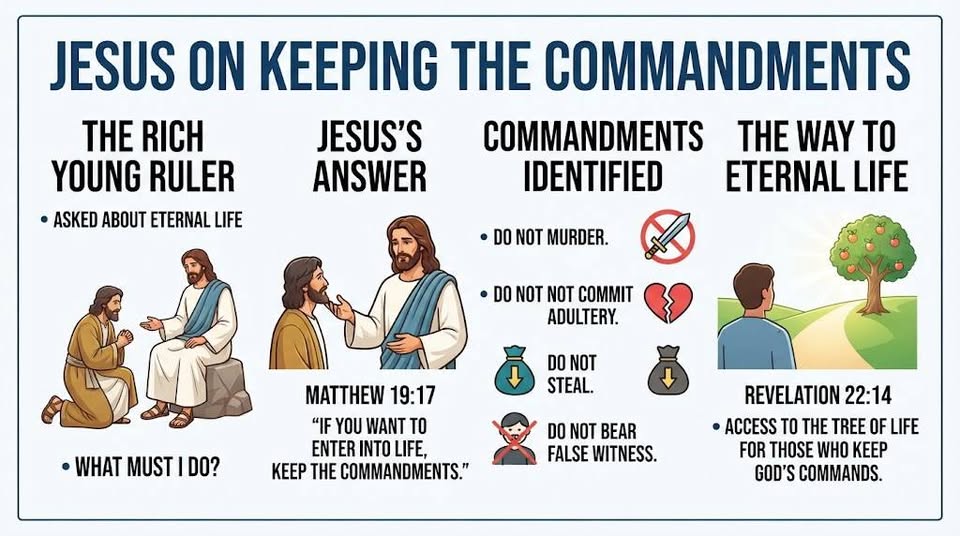
“Rich Young Ruler” and Jesus’ Command “Keep the Commandments” – Legalism or Faith? Mt. 19:16-22

Why has the Holy Spirit included Jesus’ discourse with the “rich young ruler” in Matthew 19? What is Jesus teaching?

A theological response to the confusion…

In Matthew 19:17, Jesus is in a theological discourse with a wealthy young man who approached Him asking “What must I ‘do’ to ‘inherit’ eternal life?”

Why do you call me good?

The very first thing Jesus did, out of compassion, was to provide the young man an opportunity to acquire eternal life by “faith” in Jesus as Messiah-Elohim; that is, Jesus asked, “Why do you call me ‘good’ seeing that no one is good but Elohim?” Had the young man possessed the faith, spiritual insight, to acknowledge Jesus as Elohim the Messiah, eternal life would have been granted immediately (Romans 10:13). Unfortunately, the young man did not recognize or acknowledge Jesus as Messiah; therefore, Jesus, knowing the young man’s thoughts, provided the only other alternative to eternal life, Jesus commanded, “Keep the Commandments.” The young man then assumed himself on fertile ground as he felt himself to be righteous due all of his efforts to keep the Commandment; therefore, he asked Jesus, “Which ones?” Jesus recited a number of moral commands to which the young man boldly and proudly stated that he had kept them; then, Jesus proceeded to demonstrate to the young man that he had NOT kept the Commandments but had failed to keep the Greatest of Commandments; Jesus, once again, provided the young man a second opportunity to find eternal life by faith and commanded the young man to “follow me.” Jesus told the young man to sell all of his wealth, distribute it to the poor and “follow me!” Had the young man complied by faith, eternal life would have manifest in the young man’s life.

The relevance of the young man’s wealth?

The young man walked away sad and disheartened because he loved his wealth more than Elohim thus demonstrating that he did not keep the Greatest Commandments to love Elohim above all else and to love your neighbor as yourself but the young man had made an idol of his wealth (Matthew 22:36-40).

I tell you this protracted story because you are DEAD WRONG if you think anyone but Jesus keeps the Commandments in perfection (Romans 3:23) which divine perfection is absolutely necessary if righteousness (a right standing) with Elohim is to manifest (James 2:10) through works of the Law (Galatians 2:16) and you are DEAD WRONG if you think the Law does anything but CURSE the one who seeks righteousness (a right standing with Elohim) through it (Galatians 3:10). As a result of the Adamic sin-nature (Romans 5:12) the Law is a curse to all of humanity; therefore, mankind requires a perfect Intercessor if righteousness (a right standing) with the Father is to manifest with purity and authenticity (1 Timothy 2:5; John 14:6).

If you desire eternal life,

IF YOU DESIRE ETERNAL LIFE YOU MUST HUMBLE YOURSELF AND APPROACH ELOHIM (Genesis 1:1) BY FAITH AS AN UNWORTHY SINNER THAT YOU ARE AND ASK FORGIVENESS, REPENT OF YOUR SIN, TRUST FULLY IN JESUS AS YOUR MESSIAH WHO SHED HIS BLOOD FOR THE ATONEMENT OF YOUR SIN AT GOLGOTHA! John 3:16; 1 Peter 1:18-19

Humanity finds righteousness with Elohim NOT by what we do but in Whom we “believe.” John 3

Christians “work,” they produce divine “fruit” (Galatians 5:22-23), “subsequent salvation” by faith in Jesus as Christians “walk by the Spirit” (Galatians 5:16) in faith as they love Elohim and honor Him through obedience to the indwelling Holy Spirit, not enslavement to a bygone law covenant given specifically to Israel’s children for eschatological purposes (Romans 7:6; Hebrews 8:7). The Law curses one to death; Jesus saves you through His death at Golgotha (Romans 8:1-7)! Know the difference and LIVE!

Did Jesus deny His deity in Matthew 19:17?

Did Jesus deny His deity in Matthew 19:17?

16 Now behold, one came and said to Him, “Good Teacher, what good thing shall I do that I may have eternal life?”

17 So He said to him, “Why do you call Me good? No one is good but One, that is, God. But if you want to enter into life, keep the commandments.”

Jesus was not denying His deity during his discourse with the rich young ruler (Matthew 19:16-22) but Jesus provided the rich young ruler an opportunity to receive eternal life by faith in Jesus as Messiah (Matthew 16:19-22). The young man approached Jesus asking what he “must do” to inherit eternal life and politely referred to Messiah Jesus as “good Teacher” (a Rabbi)…Jesus used this opportunity to provide the only true Path to Eternal LIFE which is belief-faith that Jesus is indeed Messiah – God – Elohim – our Creator. Jesus essentially asked the young if he was calling Jesus Deity…Elohim…Messiah…did the young man see and acknowledge the Truth of Messiah standing before him…did the young man know Jesus as the Christ just as Peter had confessed Jesus as the Messiah (Matthew 16:13-20)?

The young man did not acknowledge Jesus as Messiah; therefore, Jesus offered the young man what was and continues to this day as a prevailing false ideology relevant to earning one’s salvation through works of the flesh e.g. “keep the Commandments.” The young man insisted that he had indeed kept the Commandments at which time Jesus proceeded to prove to the young man that he had failed to keep the Greatest Commandments by offering the young man another opportunity to receive eternal life by “faith” as Jesus commanded the young man to sell all that he had, distribute his wealth to the poor, come and “Follow ME!” Unfortunately, the young man loved his wealth more than Elohim as the young man walked away sad having made an idol out of his wealth thereby violating the greatest Commandments to honor no god but Elohim; to love the Lord your God with all your heart and with all your soul and with all your mind; to eschew the worship of idols; to love your neighbor as yourself.

Jesus was NOT denying His deity before the young rich ruler but Jesus offered the young man no less than two opportunities to receive eternal life by “faith” in Jesus as his Messiah. No one inherits eternal life through works of the law or striving in self-righteousness; this truism was first demonstrated for humanity in Genesis 3:21 as Elohim rejected Adam’s attempt to cover his sin and shame with fig leaves (the works of his hands) yet Elohim shed innocent blood, Himself, and clothed Adam and Eve in an imputed-gifted robe of righteousness; Jesus did this very thing for all of humanity at Golgotha and that imputed robe of righteousness is received by faith, not works (2 Corinthians 5:21; Galatians 2:16).