
Catholicism: a religious works cult?

Catholicism has NEVER been Christianity and Peter was NEVER a Pope. Emperor Constantine via the Edict of Milan (312-313AD) sought greater control over the burgeoning Roman Empire and sought to make Christianity more attractive or palatable to the masses; therefore, Constantine merged Babylonian/Roman paganism with non-inspired Apocryphal writings mingled with Christian doctrine to form the World’s 2nd largest religious works cult AKA Catholicism, 2nd only to Islam in numbers and in deception. Catholicism blasphemes the Gospel message based in grace through faith in Jesus, alone.
2 thoughts on “Catholicism: a religious works cult?

  1. The timeline and the premises behind it are virtually entirely historically false.

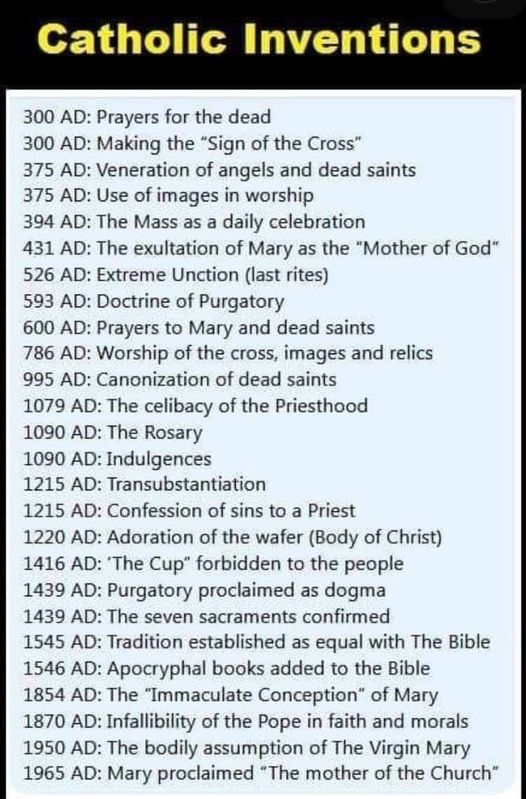
    This graphic is a copy of the infamous “List of Catholic Inventions” originally compiled by Loraine Boettner in his 1962 anti-Catholic book Roman Catholicism. It is widely recognized by church historians, theologians, and secular historians alike—both Catholic and Protestant—as factually inaccurate and historically illiterate.

    The Big Historical Flaws

    1. Fabricated or Misleading Dates

    Almost every date assigned on the list is either completely made up or marks a much later official council decree rather than when the practice actually began.

    • Sign of the Cross (listed as 300 AD): The Christian writer Tertullian wrote in 211 AD (nearly a century earlier): “In all our travels and movements… we mark our foreheads with the sign [of the cross]”.
    • Prayers for the Dead (listed as 300 AD): Praying for the dead is an ancient Jewish practice preceding Christianity (e.g., 2 Maccabees 12:42-45). Catacomb inscriptions from the 1st and 2nd centuries explicitly contain Christian prayers for deceased loved ones.
    • Extreme Unction / Anointing of the Sick (listed as 526 AD): This practice comes directly out of the New Testament: “Is anyone among you sick? Let them call the elders of the church to pray over them and anoint them with oil in the name of the Lord” (James 5:14).

    2. Confusing “Dogmatization” with “Invention”

    Many dates on the list cite the year a belief was formally defined at a Church Council, claiming that was the date it was “invented.”

    • Transubstantiation (listed as 1215 AD): The Fourth Lateran Council in 1215 AD used the philosophical word transubstantiation to formally clarify the mechanics of the Real Presence. However, belief that the bread and wine become the actual body and blood of Christ was written about continuously by early Christians, including St. Ignatius of Antioch (c. 110 AD) and St. Justin Martyr (c. 150 AD).
    • “Mother of God” / Theotokos (listed as 431 AD): The Council of Ephesus in 431 AD affirmed Mary as Theotokos (“God-bearer”) to refute a heresy about Jesus’s dual nature (Nestorianism), not to “invent” a new title for Mary. The title had already been in common Christian use for over 150 years (e.g., in Origen’s writings and early hymns like the Sub Tuum Praesidium from c. 250 AD).

    3. Bizarre Historical Myths (Constantine & Paganism)

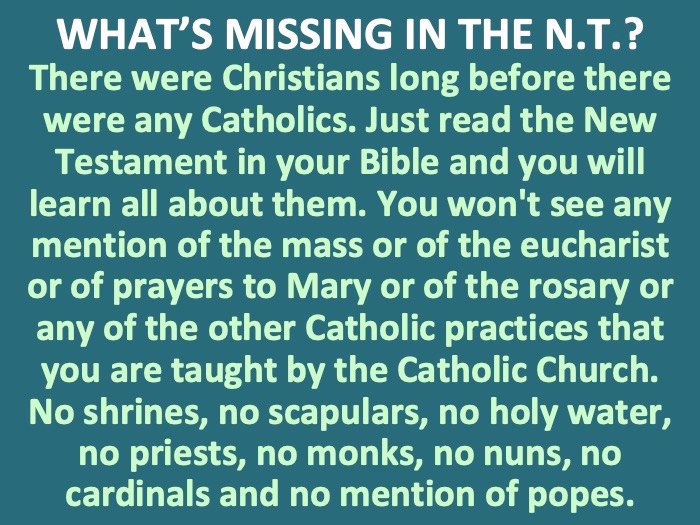
    The text accompanying the image repeats the “Constantine/Pagan Merge” conspiracy theory (often linked to Alexander Hislop’s debunked 19th-century book The Two Babylons).

    • Constantine’s Edict of Milan (313 AD) merely legalized Christianity and stopped Roman persecution; Constantine did not “create” Catholicism, merge paganism into it, or establish it as the state religion.
    • The claim that early Christianity had no priests, sacraments, or liturgical structure ignores virtually all 1st and 2nd-century historical documents outside the biblical canon (such as the Didache, written c. 90–100 AD, which details baptismal rites, Eucharistic prayers, and church hierarchy).

    4. The Biblical Canon Fallacy

    The post claims “Apocryphal books [were] added to the Bible” in 1546 AD at the Council of Trent.

    • In reality, the 73-book canon (which includes the Deuterocanonical books) was formally affirmed by local councils in Hippo and Carthage in 393 AD and 397 AD.
    • These books were included in the Latin Vulgate and translated directly into standard Christian Bibles for over a thousand years. The Council of Trent in 1546 simply reaffirmed the ancient canon after Martin Luther chose to remove those books during the Reformation.

    The Takeaway

    The graphic is a collection of cherry-picked council dates, historical misunderstandings, and outright fabrications designed to make long-standing early Christian traditions look like medieval corruptions.

    Like

    1. Catholicism is a religious cult of works found in paganism and non-inspired apocryphal doctrine. I fear that many well intentioned man and woman and child are firmly rooted on the broad path and the wide gate due to the Catholic catechism. Thank you for sharing Catholic propaganda, I’m not buying nor am I agreeing.

      Like

Leave a comment